

Possible Indicators of Neglect
PHYSICAL INDICATORS IN CHILDREN | BEHAVIOURAL INDICATORS IN CHILDREN | BEHAVIOURS OBSERVED IN ADULTS WHO NEGLECT CHILDREN |
• an infant or young child may: not be growing as expected be losing weight have a “wrinkly old face” look pale not be eating well • not dressed properly for the weather • dirty or unwashed • bad diaper rash or other skin problems • always hungry • lack of medical and/or dental care • signs of deprivation that improve with a more nurturing environment (e.g., hunger, diaper rash)
| • does not meet developmental milestones as expected • appears to have little energy • cries very little • does not play with toys • does not notice or respond to people • demonstrate lack of attachment to caregiver • may become attached to any adult • may be very demanding of affection or attention from others • older children may engage in anti-social behaviour (e.g., stealing food, taking drugs, etc.) • responsible for own self-care • takes on a lot of adult responsibility at home • poor school attendance or performance • discloses neglect (e.g., says there is no one at home) | • does not provide for the child’s basic needs • has a disorganized home life, with few regular routines (e.g., always brings the child very early, picks the child up very late) • does not supervise the child properly (e.g., leaves the child alone in a dangerous place, or with someone who cannot look after the child safely) • indicates that the child is hard to care for or hard to feed; describes the child as demanding • may say that the child was or is unwanted • may ignore the child’s attempts to be affectionate • may display ignoring or rejecting behaviour towards the child • has difficulty dealing with personal problems and needs • is overwhelmed with own problems and needs; puts own needs ahead of child’s • is not very interested in the child’s life (e.g., fails to use services offered or to keep child’s appointments, does not do anything about concerns that are discussed)
|
Possible Indicators of Physical Abuse
PHYSICAL INDICATORS IN CHILDREN | BEHAVIOURAL INDICATORS IN CHILDREN | BEHAVIOURS OBSERVED IN ADULTS WHO ABUSE CHILDREN |
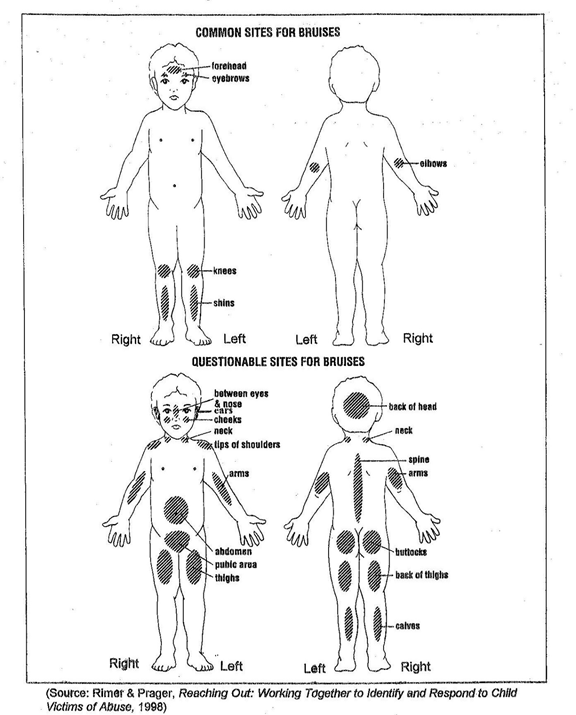
• injuries on suspicious locations (see Figure 1) • bruises in the same area of the body • bruises in the shape of an object (e.g., spoon, hand/fingerprints, belt), clustered bruising or welts burns such as that from a cigarette or in a pattern that looks like an object (e.g., iron) • burns suggesting that something was used to restrain a child (e.g., rope burns on the wrists) • wears clothes to cover up injury, even in warm weather • patches of hair missing • signs of possible head injury (e.g., skull fractures): swelling and pain nausea or vomiting feeling dizzy bleeding from the scalp or nose seizures • signs of possible injury to arms and legs: pain sensitive to touch cannot move properly limping · fractures, dislocations, multiple fractures all at once or over time · fractures in the ribs; painful breathing; difficulty raising arms • human bite marks • cuts and scrapes inconsistent with normal play • signs of female genital mutilation (e.g., trouble going to the bathroom, walking in a “waddling” manner) | • cannot remember how injuries happened • the explanation of what happened does not match the injury • refuses or is afraid to talk about injuries; denies injuries • is afraid of adults or of a particular person or gender • does not want to be touched; may cringe or flinch with physical contact • may display extremes in emotions and/or behaviours such as being very: aggressive unhappy withdrawn obedient and wanting to please uncooperative • is afraid to go home · may display hyper-vigilance, a frozen watchfulness, or vacant stare • runs away • is frequently absent with no explanation or shows signs of healing injury upon return • does not get along well with other children • shows signs of developmental delays in language and/or motor skills • has academic or behavioural problems • tries to hurt themselves (e.g., cutting oneself, suicide) • discloses abuse
| • gives harsh, impulsive, or unusual punishments • may provide inconsistent explanations as to how the child was injured • says the child is accident-prone or clumsy • shows lack of self-control with low frustration tolerance; is angry and/or impatient • may have little knowledge of child development and/or have unrealistic expectations of the child • talks about having problems dealing with the child • may be socially isolated and have little caregiving support • talks about the child as being bad, different or “the cause of my problems” • may demonstrate little or no genuine affection for the child • delays going to the doctor to have child’s injury checked • appears unconcerned, indifferent, or hostile to the child and injury |
Possible Indicators of Sexual Abuse
PHYSICAL INDICATORS IN CHILDREN | BEHAVIOURAL INDICATORS IN CHILDREN | BEHAVIOURS OBSERVED IN ADULTS WHO ABUSE CHILDREN |
• unusual or a lot of itching or pain in the throat, genital or anal area • odour or discharge from the genital area • stained or bloody underclothing • pain when trying to go to the bathroom sitting down, walking, or swallowing • blood in urine or stool • injury to the breasts or genital area: redness, bruising, cuts, swelling • poor personal hygiene • sexually transmitted infection(s) • pregnancy | • developmentally-inappropriate sexual play with toys, self, and/or others • copying the sexual behaviour of adults • knowing more about sex than is developmentally appropriate and/or expected • developmentally-inappropriate explicit drawings and/or writing • sexualized behaviours with other children or adults that are inappropriate • sexual behaviour with other children involving force or secrecy • fears or refuses to go to a parent, relative, or friend for no clear reason • does not trust others • changes in personality that do not make sense (e.g., outgoing child becomes withdrawn) • problems or change in sleep pattern (e.g., nightmares, night terrors, sleep disturbances) • recurring physical complaints with no physical basis • clinging or extreme seeking of affection or attention • goes back to behaving like a young child (e.g., bedwetting, thumb-sucking) • refuses to be undressed, or shows fear when undressing • tries to hurt oneself (e.g., uses drugs or alcohol, eating disorder, suicide) • may act out sexually or become involved in prostitution • runs away • discloses abuse | • may be unusually protective of the child • may be overinvested in the child (e.g., clings to the child for comfort) • is often alone with the child and is socially isolated • buys the child presents or gives the child money for no obvious reasons • may be jealous of the child’s relationships with others • does not like the child to be with peers while unsupervised • talk about the child being “sexy”; shows affections and/or touches the child in a sexual way • may use drugs or alcohol to feel freer to sexually abuse • engages in a relationship with the child that may be inappropriate, sexualized, or spousal in nature • allows or encourages the child to participate in sexual behaviour |
Possible Indicators of Emotional Abuse
PHYSICAL INDICATORS IN CHILDREN | BEHAVIOURAL INDICATORS IN CHILDREN | BEHAVIOURS OBSERVED IN ADULTS WHO ABUSE CHILDREN |
• the child does not develop as expected • often complains of nausea, headaches, stomach aches and/or other physical symptoms without any obvious reason • wetting or soiling self • is not given food, clothing, and care as good as what other children in the family are provided with • may have unusual appearance (e.g., strange haircuts, dress, decorations)
| • developmental delays • is unhappy, stressed out, withdrawn, aggressive or angry for long periods of time • goes back to behaving like a young child (e.g., toileting problems, thumb-sucking, constant rocking) • tries too hard to be good and to get adults to approve • tries really hard to get attention • tries to hurt oneself (e.g., uses drugs or alcohol, suicide threats or attempts) • criticizes oneself a lot • does not participate because of fear of failing • may expect too much of him/herself so gets frustrated and fails • is afraid of what the adult will do if they do something the adult does not like • sets unrealistic goals to gain adult approval • runs away • has a lot of adult responsibility and assumes parental role • does not get along well with peers • discloses abuse | • consistently rejects, insults or criticizes the child, even in front of others • does not touch or speak to the child with love and affection; withholds physical and verbal affection from the child • blames the child for problems, difficulties, disappointments • talks about or treats the child as being different from other children and family members • compares the child to someone who is disliked or hated • consistently ignores the child • actively refuses to help the child or acknowledge the child’s requests • isolates the child; does not allow the child to see others, both inside and outside the family (e.g., locks the child in a closet or room) • does not provide a good example for children on how to behave with others (e.g., swears all the time, hits others) • allows the child be involved in illegal activities • uses the child to make money (e.g., child pornography) • exposes the child to sex and violence portrayed in the media • terrorizes the child (e.g., threatens to hurt or kill the child or threatens someone or something that is special to the child) • forces the child to watch a loved one being hurt • makes excessive demans of the child |
Possible Indicators of Exposure to Family Violence
PHYSICAL INDICATORS IN CHILDREN | BEHAVIOURAL INDICATORS IN CHILDREN | BEHAVIOURS OBSERVED IN ADULTS |
• the child does not develop as expected • often complains of nausea, headaches, stomach aches and/or other physical symptoms without any obvious reason • evidence of deliberate or accidental physical harm during or after a violent episode (e.g., the child is injured intentionally or accidentally during the incident or the child is hurt as a result of thrown objects or while s/he is trying to protect others) | • may be aggressive and act out • have temper tantrums • may show withdrawn, depressed, and nervous behaviours (e.g., clinging, whining, excessive crying, separation anxiety) • acts out what has been seen or heard between the partners • overly passive, patient, compliant, and approval seeking • afraid of: someone’s anger one’s own anger (e.g., killing the abuser) self or other loved ones being hurt or killed being left alone and not cared for • sleep disturbances (e.g., cannot fall asleep, afraid of the dark, does not want to go to bed, nightmares) • bed-wetting • tries to hurt oneself (e.g., eating disorders, uses drugs or alcohol, suicide threats or attempts) • stays around the house to keep watch or tries not to spend much time at home • clumsy, accident-prone • problems with school (e.g., trouble paying attention, poor marks, misses school a lot) • expects a lot of oneself and is afraid to fail and so works very hard and gets good marks in school • takes the responsibility of helping/protecting other family members • does not get along well with peers • runs away from home • engages in cruelty to animals • may become involved in crime (e.g., stealing, assult, substance abuse, involvement with gangs) • homicidal thoughts or actions • may act out sexually or become involved in prostitution • expresses the belief that they are responsible for the violence • discloses family violence | • abuser has poor self-control, social skills, and/or communication skills • abuser has difficulty getting along with others • abuser uses threats and violence (e.g., threatens to hurt, kill or destroy someone or something that is special; cruel to animals) • forces the child to watch a parent/partner being hurt • abuser is always monitoring what the partner is doing • abuser insults, blames, and criticizes partner in front of others • jealous of partner talking or being with others • abuser does not allow the child or family to talk with or see others • abuser expresses strong belief in traditional male/female roles (e.g., men have the power and women have to obey) • abuser makes excessive demans of partner • the abused person is not able to care properly for the children because of isolation, depression, trying to survive, or financial constraints • uses drugs or alcohol • the abused person seems fearful • discloses family violence • discloses that the abuser assaulted or threw objects at someone holding a child |